

Self-custody wallets put users in complete control of their cryptocurrency by giving them direct ownership of private keys – no banks, no exchanges, no middlemen calling the shots. Unlike custodial wallets where third parties hold the keys, self-custody solutions like hardware devices and smartphone apps eliminate dependency on centralized institutions. While this freedom brings enhanced privacy and financial sovereignty, it demands serious technical competence and personal responsibility. The true cost of crypto independence lies in what comes next.
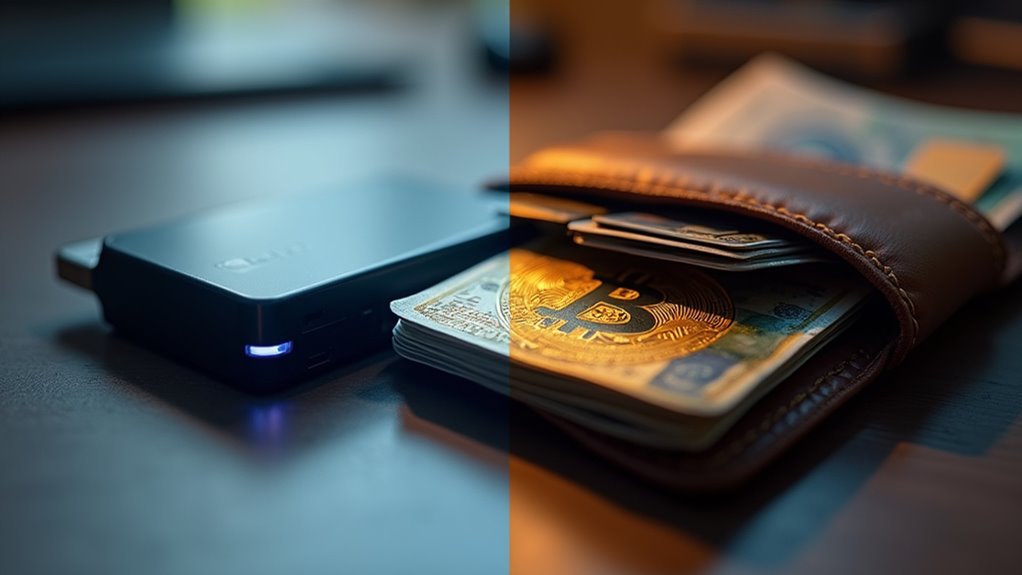
Self-custody wallets represent a radical departure from traditional financial custody, putting complete control of cryptocurrency assets directly in users’ hands. Unlike centralized exchanges where third parties hold the keys to your digital kingdom, self-custody wallets strip away the middleman, leaving users with both absolute control and total responsibility. Hardware wallets like Trezor and others serve more than 2 million users worldwide. It’s the digital equivalent of stuffing cash under your mattress – if your mattress were a highly sophisticated piece of cryptographic technology.
These wallets, also known as non-custodial wallets, come in various forms – from ultra-secure hardware devices that look like USB sticks to smartphone apps that transform your mobile device into a crypto command center. Solutions like Coinbase Wallet give users full private control while offering advanced security features. Each type serves different needs, but they all share one essential feature: the user holds the private keys. This isn’t just a technical detail; it’s a fundamental shift in how people interact with their money.
The appeal of self-custody is obvious – no more trusting exchanges that might get hacked, freeze assets, or simply disappear overnight with users’ funds. But this freedom comes with a sobering reality check: lose your private keys or seed phrase, and your crypto vanishes into the digital void. No customer service hotline. No password reset. No recovery options. The blockchain is utterly indifferent to human error. Setting up these wallets requires creating a strong password and safely storing recovery phrases.
Self-custody grants ultimate financial freedom but demands perfect vigilance – one wrong move and your crypto wealth vanishes forever into the blockchain abyss.
Security in self-custody wallets extends beyond just protecting private keys. Users must navigate a landscape filled with sophisticated phishing attempts, malware, and social engineering attacks. The system demands a level of technical literacy and vigilance that many traditional banking customers have never needed to develop. Paper wallets provide an offline alternative for those seeking maximum security against digital threats. Unlike traditional wallets that store actual currency, these wallets secure blockchain access through cryptographic keys.
Yet for those willing to climb the learning curve, the rewards include enhanced privacy, direct access to decentralized finance (DeFi) protocols, and participation in blockchain governance.
The irony isn’t lost on crypto veterans: the same features that make self-custody wallets powerful tools for financial sovereignty also make them potentially dangerous for inexperienced users. It’s like handling a high-performance sports car – thrilling when you know what you’re doing, potentially catastrophic when you don’t.
The system forces users to confront an uncomfortable truth: true financial independence requires both technical competence and personal responsibility.
For frequent traders, self-custody might feel like overkill, trading convenience for security. But for those serious about long-term crypto holdings or privacy, these wallets represent the purest expression of blockchain’s original promise: financial tools that answer to no one but their users.
Frequently Asked Questions
What Happens to My Crypto if I Lose My Device?
Losing a device doesn’t mean losing crypto – it’s stored on the blockchain, not the phone or computer.
Think of the device as a key, not a vault. With a properly backed-up seed phrase (those 12-24 secret words), funds remain accessible by simply restoring the wallet on a new device.
However, immediate action is essential if there’s any chance the seed phrase was stored on or accessible through the lost device.
Can I Recover My Wallet if I Forget My Password?
Recovery options exist but vary based on the specific situation.
With a forgotten password but intact seed phrase, full wallet recovery is possible.
Without the seed phrase, specialized recovery software or professional services may help – though success isn’t guaranteed and costs can be steep.
The stark reality? Password recovery tools work, but they’re no magic bullet.
Best practice: Store that seed phrase securely offline and test recovery procedures regularly.
Are Self-Custody Wallets Suitable for Beginners in Cryptocurrency?
Self-custody wallets can be challenging for cryptocurrency beginners due to their steep learning curve and high responsibility.
While they offer complete control over assets, newcomers must grasp complex concepts like private keys and blockchain basics.
The irreversible nature of transactions and lack of recovery options make mistakes costly.
Hardware wallets and simpler mobile interfaces can help, but beginners should thoroughly educate themselves before diving into self-custody solutions.
How Much Does It Cost to Maintain a Self-Custody Wallet?
The cost of maintaining a self-custody wallet varies considerably. Basic software wallets are often free, while hardware wallets require a one-time investment of $50-$200.
The real expenses lie in security measures: backup solutions ($50-$200), safe deposit boxes ($30-$200 annually), and potential consulting fees ($200-$1000).
Hidden costs include time spent managing keys and network transaction fees. Regular hardware upgrades every 3-5 years may also be necessary.
Can I Connect My Self-Custody Wallet to Cryptocurrency Exchanges?
Yes, self-custody wallets can connect to most major cryptocurrency exchanges.
The connection process typically requires API key setup or wallet address whitelisting for secure transfers. This integration enables direct trading while maintaining control of assets, faster deposits/withdrawals, and automated trading capabilities.
However, users should exercise caution with API security, enable all available protection features, and regularly audit connected applications to prevent unauthorized access.


