Bitcoin mining today isn’t for the faint-hearted or undercapitalized. Successful mining requires specialized ASIC hardware like the Antminer S19, secure wallet setup (preferably hardware wallets), and membership in a mining pool – solo mining is fundamentally dead. Miners need robust cooling systems, stable internet, and reliable power supplies. With current Bitcoin prices, operations require around $27,000 per coin in infrastructure and energy costs. Profitability hinges on factors that most beginners aren’t prepared to handle – but there’s more beneath the surface.
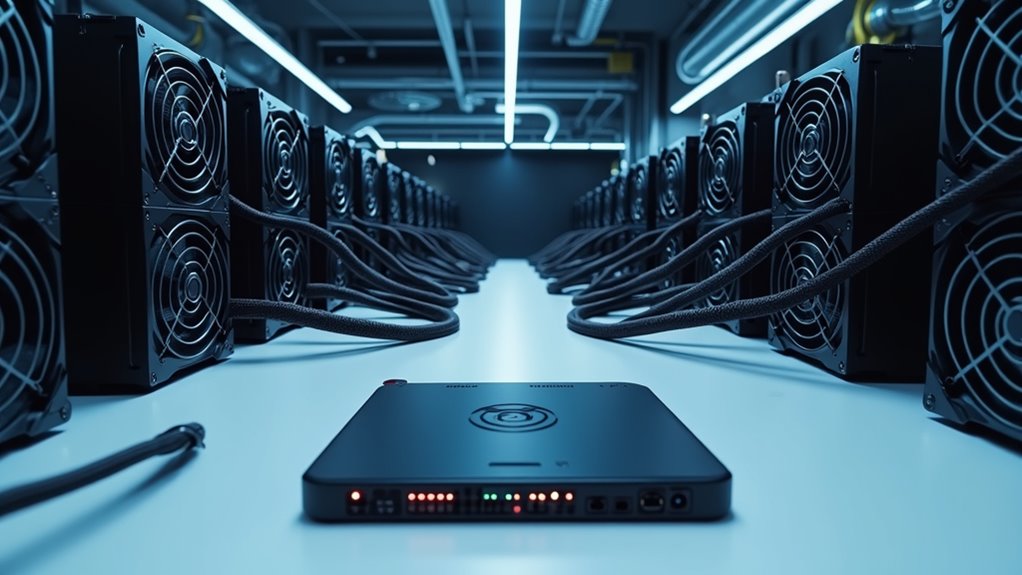
Mining Bitcoin in 2024 represents a complex intersection of computing power, electrical consumption, and financial strategy that extends far beyond the simplified narratives of crypto evangelists. The reality is stark: successful Bitcoin mining now demands industrial-scale operations, leaving the days of profitable home mining firmly in the rearview mirror.
For those still determined to enter this high-stakes game, the first vital decision revolves around hardware selection. ASIC miners like the Antminer S19 and Whatsminer M30S++ dominate the field, having rendered GPU mining obsolete for Bitcoin. These specialized machines don’t come cheap, and their efficiency metrics – hash rate versus power consumption – can make or break profitability. ASICs deliver superior performance compared to traditional GPU mining rigs. The difficulty target adjusts automatically every two weeks to maintain consistent 10-minute block intervals.
Setting up a secure wallet serves as the foundation for any mining operation. While software wallets offer convenience, hardware solutions like Ledger or Trezor provide military-grade security for storing mining rewards. This isn’t just about storing digital assets; it’s about protecting the fruits of substantial investment in equipment and electricity. Some miners are diversifying their revenue streams by AI data hosting to maintain profitability in challenging market conditions. Cloud mining services offer an alternative way to participate without managing physical hardware, though remote data centers require thorough verification to avoid potential scams.
Securing mining rewards demands more than convenience – it requires fortress-level protection for your hard-earned digital assets.
The mining software landscape presents several battle-tested options, with CGMiner and BFGMiner leading the pack. These programs serve as the bridge between hardware and mining pools, requiring precise configuration of pool credentials and wallet addresses. The days of solo mining Bitcoin have long passed – joining a mining pool isn’t optional, it’s essential for consistent returns.
Behind the scenes, successful mining operations demand meticulous attention to infrastructure. Proper cooling systems, stable internet connectivity, and robust power supplies form the backbone of any mining setup. The reality is brutal: even minor downtime can considerably impact profitability in this razor-thin margin business. Major mining operations can achieve a cost per Bitcoin of approximately $27,000 with optimal infrastructure and efficiency.
Profitability calculations require constant vigilance. Mining calculators offer a starting point, but the real math involves juggling variables like electricity costs, hardware depreciation, and network difficulty increases. Smart operators explore alternative energy sources and locations with cheaper power rates to maintain viability.
The regulatory landscape adds another layer of complexity. Mining operations must navigate a maze of local regulations, tax obligations, and potential restrictions on power usage. What started as a decentralized dream now requires careful consideration of business structures, record-keeping requirements, and compliance frameworks.
The truth about Bitcoin mining in 2024 is unforgiving: it’s an industrial-scale operation requiring considerable capital, technical expertise, and strategic planning. For those still entertaining dreams of mining from their garage, the wake-up call is clear: this isn’t a hobby anymore – it’s big business.
Frequently Asked Questions
What Happens to My Mining Rewards if My Internet Connection Drops?
When internet connectivity drops, mining rewards immediately stop accumulating. The miner can’t receive new transaction data or submit solved blocks, resulting in zero hashrate contribution and wasted energy costs.
While the hardware continues consuming power, no rewards are earned. Upon reconnection, miners must resynchronize with the blockchain and may face increased stale share rates.
Using redundant internet connections and wired Ethernet can help prevent these losses.
Can I Mine Bitcoin Using a Virtual Private Server (VPS)?
While technically possible, VPS mining for Bitcoin is largely impractical and often prohibited.
Most VPS providers explicitly ban crypto mining in their terms of service, risking account suspension if detected. The hardware isn’t optimized for mining like ASICs, resulting in poor profitability.
Combined with Bitcoin’s high mining difficulty, VPS mining yields minimal returns while potentially violating provider agreements.
Alternative cryptocurrencies might be more suitable, but the risks still outweigh potential rewards.
How Often Should I Update My Mining Software?
Mining software typically requires updates 2-3 times annually for major releases, with minor patches rolling out monthly.
Smart miners check manufacturer websites weekly and subscribe to provider notifications. Regular updates aren’t just optional – they deliver critical security patches, performance boosts, and bug fixes that directly impact profitability.
Before fleet-wide implementation, testing updates on a single miner prevents system-wide disruptions and allows for proper troubleshooting.
What Countries Have Banned or Restricted Bitcoin Mining?
Several nations have implemented outright bans on Bitcoin mining, with China’s 2021 crackdown being the most significant.
Algeria, Bangladesh, Egypt, and Nepal have total prohibitions in place.
Other countries maintain partial restrictions: Iran regulates mining seasonally, Kosovo imposed temporary bans during energy crises, and Kazakhstan introduced strict licensing requirements.
The EU and US are exploring regulations, while India and Pakistan contemplate restrictions primarily due to energy consumption concerns.
Do I Need to Pay Taxes on My Bitcoin Mining Income?
Yes, bitcoin mining income is fully taxable in most jurisdictions.
Miners must report the fair market value of tokens received as ordinary income and pay additional capital gains tax when selling mined coins.
The IRS treats mining rewards as self-employment income if done as a business, requiring both income and self-employment tax payments.
Proper record-keeping is essential – tracking mining dates, values received, and eventual sales.